
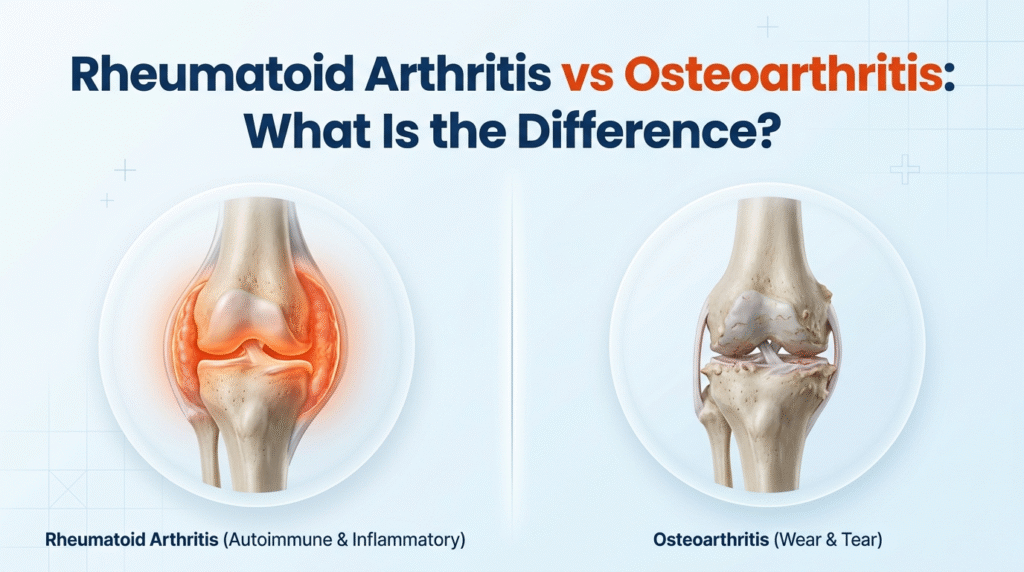
Rheumatoid Arthritis vs Osteoarthritis: What Is the Difference?
Rheumatoid Arthritis vs Osteoarthritis: What Is the Difference? The main difference is that rheumatoid arthritis is an autoimmune disease in which the immune system mistakenly attacks healthy joint tissues, while osteoarthritis is a condition involving changes and breakdown in the cartilage and other structures of a joint. Both conditions can cause joint pain, stiffness, swelling, and difficulty moving, but they develop for different reasons and may require different treatments. Understanding these differences can help people recognise possible symptoms and seek the right medical assessment.
Arthritis is a general term for conditions that affect the joints. A joint is where two bones meet, such as the knee, wrist, or elbow. Healthy joints allow people to walk, bend, lift objects, write, and perform everyday activities comfortably. When a joint becomes affected by arthritis, movement may become painful or difficult.
Rheumatoid arthritis (RA) is a long-term inflammatory disease that can affect several joints and other parts of the body. Osteoarthritis (OA) is the most common type of arthritis and often develops gradually as the tissues within a joint change over time. Although osteoarthritis is more common with increasing age, it is not an inevitable part of ageing, and it can also affect younger people, especially after joint injuries or in the presence of other risk factors.
Both conditions deserve proper attention because untreated or poorly managed symptoms can affect daily life. However, their causes, patterns, diagnostic approaches, and treatment strategies differ. The following 10 points explain these differences in simple language for patients and families.
1. Causes: Autoimmune Inflammation vs Joint Tissue Breakdown
The first important difference between rheumatoid arthritis and osteoarthritis is what happens inside the joint.
In rheumatoid arthritis, the immune system normally responsible for protecting the body from harmful germs mistakenly attacks the synovium, the thin tissue lining the inside of a joint. This causes inflammation, which can lead to swelling, pain, warmth, and stiffness. If the inflammation continues without effective treatment, it may damage the cartilage and bone. Rheumatoid arthritis can also affect other parts of the body, including the eyes, lungs, skin, and blood vessels.
Osteoarthritis develops when the tissues within a joint gradually change and become damaged. Cartilage is the smooth, protective tissue covering the ends of bones. It helps the bones move against one another with less friction. In osteoarthritis, cartilage may become thinner or damaged, while the underlying bone and other joint structures may also change. Inflammation can occur in osteoarthritis too, but it is not primarily an autoimmune disease like rheumatoid arthritis.
Imagine a door hinge. In rheumatoid arthritis, the lining around the hinge becomes inflamed because the body’s defence system is attacking healthy tissue. In osteoarthritis, the surfaces and structures that help the hinge move smoothly gradually deteriorate or change. Both problems can affect movement, but the underlying processes are different.
2. Symptoms: How the Two Conditions Feel Different
Rheumatoid arthritis and osteoarthritis can both cause pain, stiffness, and swelling. However, the pattern of symptoms may provide useful clues about the underlying condition.
Rheumatoid arthritis commonly causes persistent pain, tender or swollen joints, warmth, and prolonged morning stiffness. A person may find it difficult to close their hands into a fist, button a shirt, hold a cup, or walk comfortably after waking up. Fatigue and a general feeling of being unwell can also occur because rheumatoid arthritis affects the immune system and may involve more than the joints.
Osteoarthritis often causes pain that becomes more noticeable when a person uses the affected joint. For example, someone with knee osteoarthritis may experience discomfort while climbing stairs, walking long distances, or standing for a long time. Stiffness may occur after waking up or sitting still, but it often improves within a shorter period. The joint may also feel less flexible, and some people notice grinding or clicking during movement.
These patterns are not absolute rules. Rheumatoid arthritis can cause pain during movement, and osteoarthritis can cause swelling and stiffness. Symptoms also vary according to disease severity and the joints involved. A clinician considers the complete pattern rather than diagnosing a condition from one symptom alone.
3. Affected Joints: Where Does Each Type of Arthritis Usually Occur?
The joints affected can help a clinician distinguish rheumatoid arthritis from osteoarthritis, although there is considerable overlap.
Rheumatoid arthritis frequently affects the small joints of the hands, fingers, wrists, and feet. It can also involve the knees, ankles, elbows, shoulders, and other joints. The condition often affects similar joints on both sides of the body. For example, a person may experience swelling in both wrists or pain in corresponding finger joints.
Osteoarthritis commonly affects the knees, hips, hands, and spine. In the hands, it often involves the joints near the fingertips, the middle joints of the fingers, and the base of the thumb. It can also affect joints that have experienced previous injuries or repeated stress. Symptoms may begin in one or a few joints, although several joints can eventually be affected.
Consider two examples. One person has swelling in both wrists and several finger joints, together with prolonged morning stiffness. Another experiences knee pain mainly while climbing stairs, with stiffness after sitting for a long time. These patterns may suggest different conditions, but they cannot confirm a diagnosis.
Both rheumatoid arthritis and osteoarthritis can affect daily activities. The location of the pain, the duration of symptoms, the presence of swelling, and the person’s medical history all help guide further assessment.
4. Morning Stiffness: Why Does the Duration Matter?
Morning stiffness is a common symptom in both rheumatoid arthritis and osteoarthritis, but its duration and associated symptoms can differ.
In rheumatoid arthritis, stiffness often lasts longer than 30 minutes and may continue for an hour or more. The joints can feel swollen, tender, or difficult to move after several hours of rest. A person may need extra time in the morning to dress, prepare breakfast, or begin walking comfortably. This prolonged stiffness is linked to inflammation in the joint lining.
In osteoarthritis, stiffness after waking up or sitting still often lasts for a shorter period, commonly less than 30 minutes. Movement may gradually improve comfort, although pain can increase later when the affected joint is used extensively.
These time ranges are general patterns, not strict diagnostic rules. Some people with rheumatoid arthritis experience shorter periods of stiffness, while some people with osteoarthritis have symptoms that last longer. Other inflammatory conditions can also cause prolonged morning stiffness.
Keeping a record of how long stiffness lasts, which joints are affected, and whether swelling occurs can help during a medical consultation. Persistent stiffness accompanied by swollen joints should not be ignored, even if the symptoms improve as the day progresses.
5. Joint Swelling: Inflammation and Structural Changes
Joint swelling can occur in both conditions, but the reasons for it may differ.
In rheumatoid arthritis, inflammation causes the synovium to become thicker and irritated. Fluid may also accumulate inside the joint. As a result, the affected area may appear puffy, feel warm, or become tender when touched. Several joints may swell at the same time, and symptoms can fluctuate during periods of increased disease activity.
In osteoarthritis, swelling may result from irritation of the joint, changes in the surrounding tissues, or the accumulation of fluid. Bony enlargements can develop around some finger joints as the condition progresses. The affected area may feel stiff or enlarged, especially after activity, but pronounced warmth and widespread inflammatory symptoms are less typical than in active rheumatoid arthritis.
The appearance of swelling alone cannot establish which type of arthritis a person has. Infection, gout, injuries, and other conditions can also cause a swollen joint.
A suddenly hot, very painful, swollen joint, particularly when accompanied by fever, requires urgent medical assessment because a joint infection may be responsible. Persistent or recurring swelling should also be assessed to identify its cause and determine whether treatment is needed.
6. Who Can Develop Rheumatoid Arthritis or Osteoarthritis?
Both conditions can affect different age groups, but some risk factors differ.
Rheumatoid arthritis can begin at different ages, including in adulthood and later life. It is more common in women than in men. Genetic susceptibility, smoking, and certain environmental factors may contribute to the risk. However, a person can develop rheumatoid arthritis without having a family history of the disease.
Osteoarthritis becomes more common as people age because the tissues in joints undergo changes over time. However, age is not the only factor. Previous joint injuries, excess body weight, joint structure, family history, and repeated strain may also contribute. Younger adults can develop osteoarthritis, particularly after a significant joint injury.
It is important not to assume that every older person with joint pain has osteoarthritis or that a younger person cannot have arthritis. Likewise, joint pain in someone with a family history of rheumatoid arthritis does not automatically mean they have the condition.
A clinician evaluates symptoms, medical history, examination findings, and relevant tests to understand the likely cause. Identifying the condition correctly is important because the treatment approaches are not the same.
7. Diagnosis: How Do Doctors Tell the Difference?
There is no single test that can reliably distinguish every case of rheumatoid arthritis from osteoarthritis. Diagnosis usually involves a combination of medical history, physical examination, and investigations selected according to the symptoms.
For suspected rheumatoid arthritis, a clinician may check for joint swelling, tenderness, warmth, and reduced movement. Blood tests may include rheumatoid factor (RF), anti-cyclic citrullinated peptide (anti-CCP) antibodies, C-reactive protein (CRP), and erythrocyte sedimentation rate (ESR). These tests can provide evidence of an autoimmune condition or inflammation, but normal results do not exclude every case of rheumatoid arthritis.
For suspected osteoarthritis, diagnosis often relies on the person’s symptoms and examination. X-rays may reveal narrowing of the space between bones, bone spurs, or other structural changes. Additional imaging may be considered when the diagnosis is uncertain or another problem is suspected.
Blood tests and imaging may be used in either condition when appropriate. The important difference is that rheumatoid arthritis often requires investigation for systemic inflammation and autoimmune markers, whereas osteoarthritis is usually assessed through symptoms, examination, and structural changes.
Accurate diagnosis matters because treating the wrong condition can delay appropriate care. People with persistent swelling, prolonged morning stiffness, or unexplained joint pain should seek medical assessment rather than relying on self-diagnosis.
8. Treatment: Why the Medicines Can Be Different
Rheumatoid arthritis and osteoarthritis require different treatment strategies because their underlying causes differ.
For rheumatoid arthritis, the main goal is to control the immune-driven inflammation and prevent joint damage. Disease-modifying antirheumatic drugs (DMARDs) are central to treatment. Depending on the person’s condition, a rheumatologist may prescribe conventional DMARDs, biologic medicines, or targeted synthetic therapies. These medicines act on the disease process and can help reduce inflammation and protect joint function. Pain-relieving medicines may also be used when appropriate.
For osteoarthritis, treatment focuses on reducing pain, improving movement, and supporting the affected joint. Management may include suitable exercise, physiotherapy, strengthening the muscles around the joint, weight management where appropriate, activity adjustments, and medicines for symptom relief. Some people with severe osteoarthritis may require surgical assessment, including consideration of joint replacement.
Neither condition should be treated with medication chosen without professional advice. Some medicines suitable for one person may be unsafe for another because of other illnesses, possible side effects, or interactions with existing medicines.
Regular follow-up is useful in both conditions. In rheumatoid arthritis, it helps assess disease activity and medication safety. In osteoarthritis, it helps review pain control, mobility, exercise tolerance, and whether additional treatment is needed.
9. Lifestyle and Everyday Joint Care
Daily habits can help people manage symptoms of both rheumatoid arthritis and osteoarthritis, although lifestyle changes do not replace appropriate medical treatment.
For rheumatoid arthritis, gentle physical activity can help maintain flexibility, muscle strength, and general fitness. During periods of active inflammation, exercise may need to be adjusted to avoid placing too much strain on painful or swollen joints. Physiotherapists can recommend suitable movements and ways to protect joint function.
For osteoarthritis, strengthening exercises and appropriate low-impact activities can help support the affected joints. Maintaining a healthy weight, when relevant, may reduce stress on weight-bearing joints such as the knees and hips. Comfortable footwear, pacing activities, and taking breaks when needed can also help manage symptoms.
For both conditions, a balanced diet, adequate sleep, and regular medical follow-up support overall health. People should avoid relying on unproven supplements or restrictive diets as substitutes for treatment.
A useful practical step is to keep a symptom diary. Record which joints hurt, when stiffness occurs, whether swelling appears, and which activities make symptoms better or worse. This information can help the healthcare professional make informed decisions about diagnosis and management.
The best routine depends on the person’s condition, level of pain, mobility, and other health needs.
10. Why Early Assessment and Specialist Care Matter
Rheumatoid arthritis can cause lasting damage if inflammation remains uncontrolled. Early diagnosis and appropriate disease-modifying treatment can help reduce inflammation, protect joint function, and lower the risk of long-term complications. Because rheumatoid arthritis may also affect organs beyond the joints, ongoing medical monitoring is important.
Osteoarthritis can also interfere with daily life when pain and stiffness become persistent. Appropriate management can help people remain active, improve strength, and maintain independence. If symptoms become severe despite non-surgical treatment, further assessment may be necessary to discuss additional options.
Frequently Asked Questions
Rheumatoid arthritis is an autoimmune disease in which the immune system attacks the lining of the joints, causing inflammation. Osteoarthritis is a joint condition associated with changes in cartilage and other joint tissues over time. Both can cause pain, stiffness, and reduced movement, but their causes and treatments differ.
Rheumatoid arthritis develops when the immune system mistakenly attacks healthy joint tissue. Osteoarthritis develops through changes in the joint, including cartilage breakdown and changes to the underlying bone. Age, previous joint injuries, genetics, and excess joint stress can contribute to osteoarthritis.
Rheumatoid arthritis commonly affects the small joints of the hands, fingers, wrists, and feet, often on both sides of the body. Osteoarthritis frequently affects the knees, hips, hands, and spine. However, either condition can affect different joints depending on the person.
Morning stiffness in rheumatoid arthritis often lasts longer than 30 minutes and may continue for an hour or more. In osteoarthritis, stiffness commonly improves within about 30 minutes of getting moving. These are general patterns, and symptoms alone cannot confirm a diagnosis.
Rheumatoid arthritis often causes noticeable inflammatory swelling, warmth, and tenderness in affected joints. Osteoarthritis can also cause swelling, especially during symptom flare-ups, but it is generally associated with structural joint changes. The amount of swelling varies between individuals.
Yes. A person can have both rheumatoid arthritis and osteoarthritis. For example, someone with rheumatoid arthritis may also develop osteoarthritis as they age or after a joint injury. A healthcare professional can assess symptoms and test results to identify which condition is affecting each joint.
Diagnosis usually begins with a medical history and physical examination. For suspected rheumatoid arthritis, blood tests such as rheumatoid factor and anti-CCP antibodies, along with inflammatory markers, may be used. X-rays or other imaging tests can help assess joint changes. Osteoarthritis is often diagnosed through symptoms, examination, and sometimes imaging.
Yes. Rheumatoid arthritis treatment often includes disease-modifying antirheumatic drugs (DMARDs) to control immune-driven inflammation and reduce the risk of joint damage. Osteoarthritis management may include exercise, physiotherapy, weight management when appropriate, pain-relief medicines, and joint replacement in selected cases.
Both conditions can affect daily life and cause disability. Rheumatoid arthritis can damage joints and affect other organs if inflammation is not controlled. Osteoarthritis can also lead to significant pain, reduced mobility, and joint damage. The impact depends on disease severity, affected joints, and the effectiveness of treatment.
Consider seeing a healthcare professional if you have persistent joint pain, recurring swelling, prolonged morning stiffness, or difficulty using your hands or walking. A rheumatologist can assess suspected inflammatory arthritis and help determine the appropriate treatment. A suddenly hot, red, very painful joint, especially with fever, needs urgent medical assessment.